How AI Is Quietly Tracking Your Lifespan in Real Time by 1 click
Table of Contents
The silent revolutihttps://logicloops.net/the-hidden-cellular-magic-that-could-revolutionize-in-10-days/on happening inside your smartwatch right now
Let me ask you something personal.
When was the last time you thought about how long you are actually going to live?
Not in a dark, existential way. But in a practical, “I should probably pay attention to this” kind of way.
Most of us go through our days eating whatever we feel like, sleeping inconsistently, skipping workouts without guilt, and somehow assuming that everything will work out fine in the end. We treat our bodies like rented apartments we live in them carelessly, assuming someone else will handle the maintenance.
How AI Is Quietly Tracking Your Lifespan in Real Time by 1 click
But what if something was already watching? What if artificial intelligence was quietly analyzing your sleep patterns, your heart rate variability, your blood oxygen levels, your daily steps, your stress indicators, and your glucose fluctuations all in real time and building a remarkably accurate picture of exactly how well your body is aging right now, today, at this very moment?
That is not science fiction anymore.
That is real time longevity tracking, and it is one of the most quietly explosive topics in the world of AI health technology today. It sits at the intersection of longevity science, wearable tech, machine learning, and personal health optimization and most people have never even heard the phrase.
By the end of this post, you will not only understand what real time longevity tracking is, but you will understand why it matters deeply for your future, how AI is making it possible, what the science actually says, and what you can do today to start benefiting from it.
Let us get into it.
The Problem Nobhttps://youtube.com/shorts/x_o65sM4ecY?si=wT09bM8KF1COiQOHody Is Talking About
Here is the uncomfortable truth that most health conversations skip right over.
We are living in the most medically advanced era in human history. We have cured diseases that wiped out entire populations. We have developed vaccines, surgical robots, gene therapies, and cancer treatments that would have seemed miraculous just fifty years ago.
And yet most people have absolutely no idea how their body is actually aging on the inside.
Your doctor sees you once a year, if you are lucky. They check your blood pressure, run a basic panel, tell you to eat more vegetables, and send you home. That interaction represents maybe forty five minutes of health monitoring out of eight thousand seven hundred and sixty hours in a year.
The rest of the time, you are completely flying blind.
This is the core problem that real time longevity tracking is solving. The gap between when something starts going wrong inside your body and when you actually find out about it can be months or even years. By the time most chronic diseases are diagnosed, they have already been developing quietly for a long time.
Traditional healthcare is reactive by nature. You get sick, then you get help.
Real time longevity tracking flips that completely. It is proactive, continuous, and deeply personal.
What Exactly Is Real Time Longevity Tracking?

Real time longevity tracking is the continuous monitoring of biological markers that are directly linked to how fast or how slowly your body is aging powered by artificial intelligence that can interpret that data and give you meaningful, actionable insights.
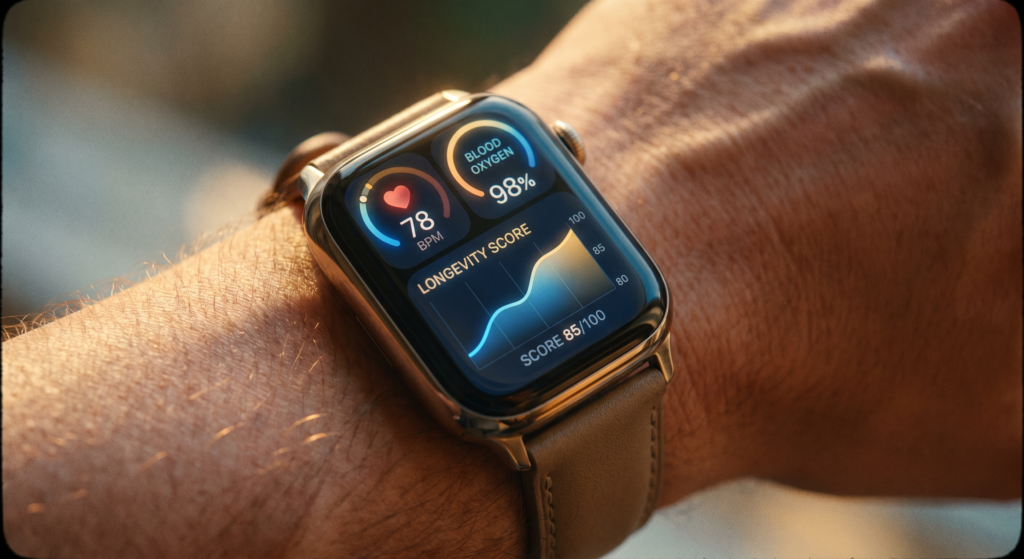
Think of it as having a brilliant, tireless research scientist living inside your wrist, your chest patch, or your smart ring, who never sleeps, never takes a break, and is constantly cross referencing your biological data against vast scientific databases to tell you something genuinely useful about your health trajectory.
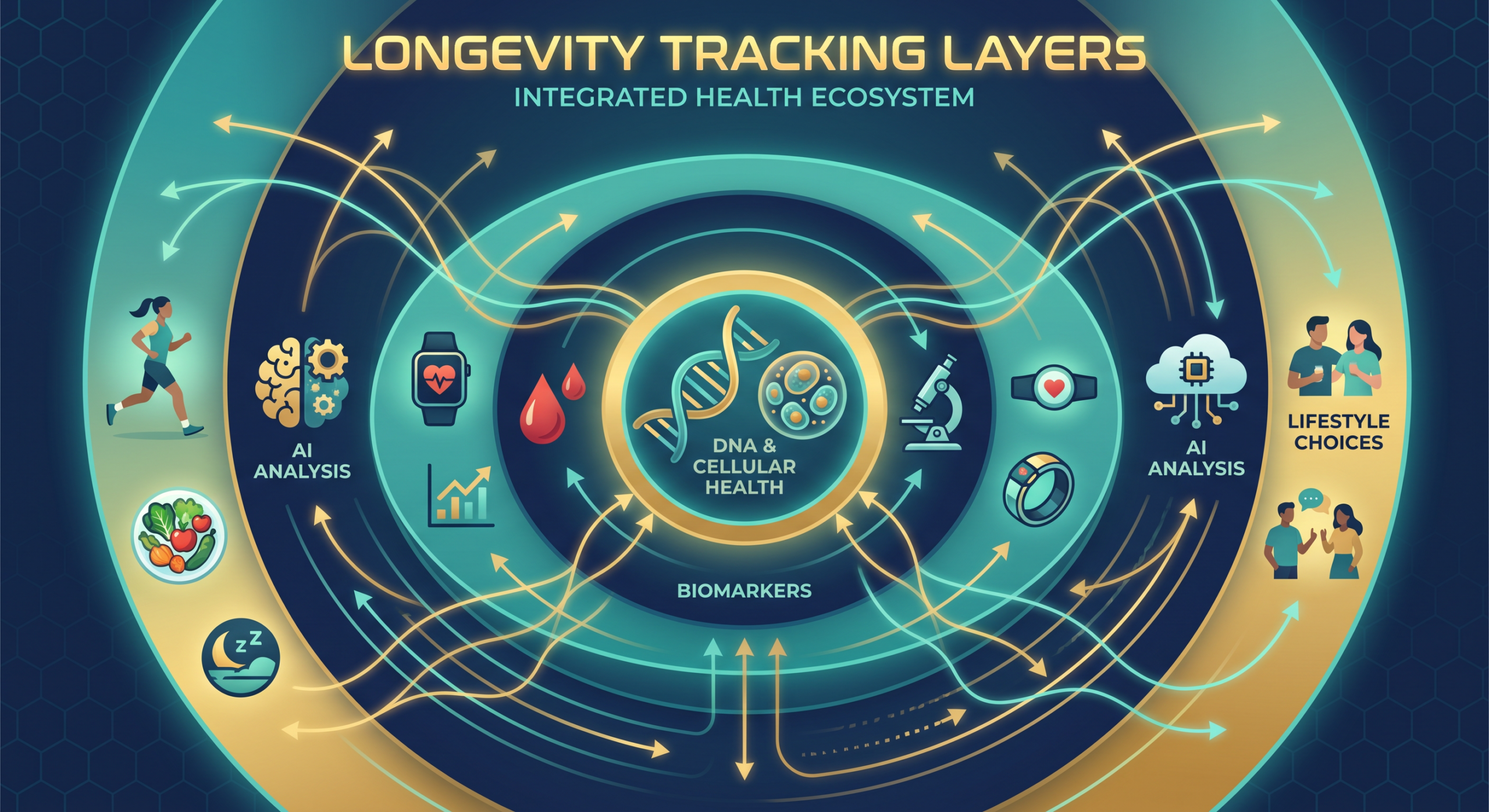
The key biological markers that AI longevity systems monitor include:
Heart Rate Variability (HRV)
This is the variation in time between your heartbeats. Counterintuitively, a less rigid, more variable pattern actually indicates better cardiovascular fitness and lower biological age. AI systems can detect subtle changes in HRV patterns that the human eye would completely miss.
Resting Heart Rate
A consistently elevated resting heart rate is one of the clearest early warning signs of cardiovascular aging. AI can track trends across months and flag when your trajectory is moving in the wrong direction.
Sleep Architecture
How much deep sleep and REM sleep you are getting matters enormously for cellular repair, memory consolidation, and immune function. Poor sleep architecture is directly correlated with accelerated aging, and AI can analyze your sleep stages with impressive precision.
Blood Oxygen Saturation
Your SpO2 levels throughout the night can reveal issues like sleep apnea, which is massively underdiagnosed and significantly linked to reduced lifespan.
Continuous Glucose Monitoring
Even if you are not diabetic, your blood sugar patterns throughout the day reveal enormous amounts of information about metabolic health, inflammation levels, and long term disease risk.
Skin Temperature Trends
Subtle shifts in skin temperature can indicate infection, hormonal changes, inflammation, and recovery status all factors that compound over time to influence biological age.
Respiratory Rate
Your breathing rate at rest is another quiet but powerful indicator of physiological stress and cardiovascular health.
What makes real time longevity tracking genuinely revolutionary is not any single one of these metrics it is the AI’s ability to look at all of them simultaneously, find patterns across time, and build what researchers call a biological age score that is often dramatically different from your chronological age.
How AI Makes This Possible
Here is where it gets genuinely fascinating.
The raw data from your wearable device is just numbers. Thousands of data points every single day. A human being even a brilliant doctor cannot meaningfully interpret that stream of information in real time.
But machine learning algorithms can.
Modern AI longevity platforms are trained on datasets containing millions of patient records, clinical studies, and biomarker analyses. They have learned to recognize patterns that correlate with specific aging trajectories, disease risks, and longevity outcomes with a level of statistical confidence that is frankly astonishing.
Companies like Whoop, Oura, Withings, Levels Health, and emerging platforms like Humanity App are already delivering versions of this technology to everyday consumers. Academic institutions and biotech companies are taking it even further organizations like the Buck Institute for Research on Aging and startups working on epigenetic clocks are developing AI systems that can estimate biological age from blood samples with extraordinary accuracy.
The concept of the epigenetic clock deserves special attention here.
Developed by researchers including Dr. Steve Horvath at UCLA, epigenetic clocks use AI to analyze patterns of DNA methylation essentially chemical tags on your DNA that change in predictable ways as you age and calculate your biological age independently of your birth year. Studies have shown that people whose biological age runs ahead of their chronological age have meaningfully higher risks of age related diseases and shorter lifespans.
The profound implication of this is that your biological age is not fixed. It responds to your lifestyle choices. And with real time longevity tracking, you can actually see that response happening.
The Science Behind Longevity Biomarkers
Let us talk about what the actual research says, because this is where experience and expertise matter enormously.
A landmark study published in Nature Aging in 2022 analyzed data from over one hundred thousand individuals and found that a combination of just seven biological markers including resting heart rate, sleep duration, HRV, and activity levels could predict all cause mortality risk with significant accuracy when tracked continuously over time.
Another study published in Cell demonstrated that continuous glucose monitoring in non-diabetic individuals revealed dramatic differences in post meal blood sugar responses to identical foods differences that would never be visible through annual fasting glucose tests, and differences that have profound long term implications for metabolic health and aging.
Research from the Stanford University School of Medicine found that wearable sensor data, when interpreted by AI algorithms, could detect signs of infections, inflammatory conditions, and metabolic changes days before individuals reported any symptoms or before clinical tests would have caught anything.
These are not fringe findings. They are published in the most respected scientific journals in the world, conducted by researchers at the most prestigious institutions, using rigorous methodology.
The science is clear: continuous biological monitoring works, and AI is the tool that makes interpreting that monitoring humanly possible.
Why This Matters for Ordinary People Like You and Me

You might be reading this thinking, “This sounds impressive, but it feels like it’s for biohackers and Silicon Valley millionaires.”
I understand that instinct completely. But I want to push back on it respectfully.
The cost of entry for real time longevity tracking has dropped dramatically in the last three years. A quality continuous health monitoring system today costs less than a gym membership. The Oura Ring starts at around two hundred and ninety nine dollars. The Whoop band operates on a subscription model of around thirty dollars per month. CGM patches from companies like Levels or Supersapiens are becoming increasingly affordable.
More importantly, the value proposition here is not about vanity or optimization culture. It is about something much more fundamental.
It is about knowing.
There is a deeply human need to understand what is happening inside our own bodies. We deserve that information. We have always deserved it. AI is finally making it accessible in a way that was genuinely impossible just a decade ago.
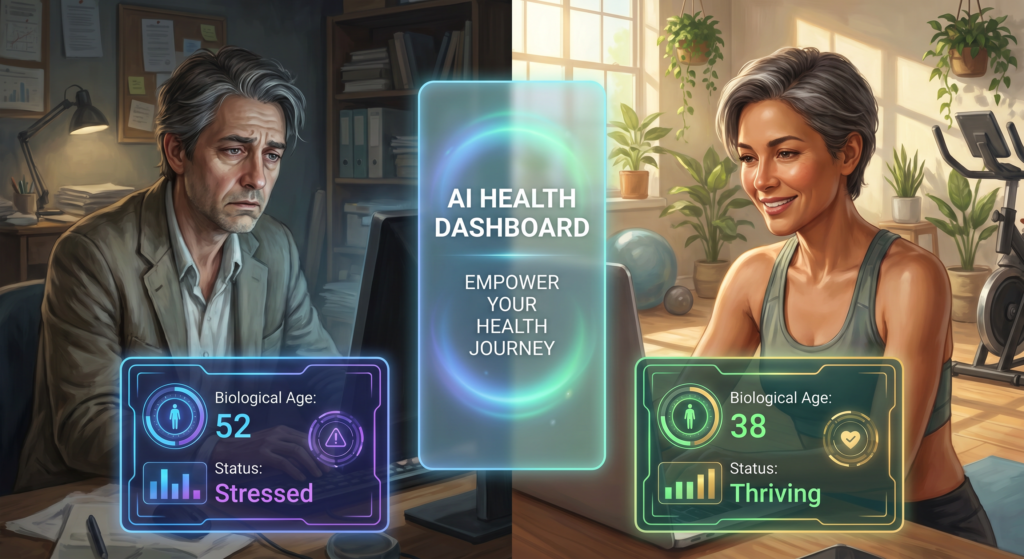
Consider what knowing your real biological age could change for you. If you discovered today that despite being forty years old chronologically, your biological markers suggested you were aging at the rate of a forty eight year old would that motivate you to make changes? Almost certainly yes.
And conversely, if you learned that your daily habits were actually keeping your biological age at thirty five despite your birth year would that not be one of the most powerful forms of positive reinforcement you could possibly receive?
Real time longevity tracking creates a feedback loop between your daily choices and your actual biological outcomes. That feedback loop is something that has been completely missing from human health for most of history.
Practical Steps to Start Tracking Your Longevity Right Now
You do not need to wait for the perfect moment or the perfect budget. Here is a genuinely practical path forward.
Step One: Start With What You Have
If you own any smartwatch or fitness tracker, open its companion app today and start paying serious attention to your resting heart rate trends and sleep data. Not single data points trends over weeks and months. That is where the meaningful information lives.
Step Two: Learn Your HRV Baseline
Heart rate variability is arguably the single most informative longevity marker available through consumer devices. Spend thirty days tracking it and establishing your personal baseline before you try to interpret individual readings.
Step Three: Experiment With Continuous Glucose Monitoring
Even one month of wearing a CGM sensor can be genuinely eye opening. Most people discover that foods they assumed were healthy are causing significant blood sugar spikes that compound over time into meaningful metabolic stress.
Step Four: Use an AI Powered Longevity App
Apps like the Humanity app, developed with input from longevity researchers, aggregate data from multiple sources and give you an actual aging rate score. Seeing that number change in response to your choices is extraordinarily motivating.
Step Five: Track Inflammation Markers Annually
Complement your wearable data with annual blood tests that include markers like hs-CRP (high sensitivity C-reactive protein), homocysteine, HbA1c, and a full lipid panel. These give your AI health picture crucial depth.
The Ethical Conversation We Need to Have
No honest discussion of AI longevity tracking is complete without acknowledging the legitimate concerns.
Data privacy is the most significant. Your continuous biological data is extraordinarily sensitive and personal. You need to read the privacy policies of any platform you use carefully, understand who owns your data, and be thoughtful about what you share and with whom.
Algorithmic bias is another real concern. Many AI health systems have been trained predominantly on data from certain demographic groups and may perform less accurately for others. This is a serious issue that the longevity tech industry is actively working to address, but it needs to be named honestly.
The anxiety question also deserves acknowledgment. For some people, continuous health monitoring creates anxiety rather than empowerment. If you have a history of health anxiety or obsessive health behaviors, approach this space thoughtfully and ideally with support from a mental health professional.
These concerns do not invalidate the technology. They inform how we should engage with it responsibly.
Conclusion: Your Future Is Being Written Right Now
Here is what I want you to take away from everything we have covered today.
Longevity is not a fixed destination that you either reach or do not. It is a trajectory that you are actively shaping through thousands of small daily decisions — and for the first time in human history, artificial intelligence can show you in real time how those decisions are actually affecting your biological age.
Real time longevity tracking is not about living forever. It is about living well, living fully, and making informed choices with the time that you genuinely have.
The gap between chronological age and biological age is real, it is measurable, and it is malleable. People are actively changing their aging trajectory through awareness, adjustment, and the kind of meaningful feedback that only continuous AI powered monitoring can provide.
You are not just a passive passenger in your own biology. You are an active participant. And now, you have better tools than any previous generation of humans has ever had to participate wisely.
The only question that remains is whether you are going to use them.
Start today. Your future self will have genuinely strong opinions about whether you did.
Have you started tracking your longevity markers? What has surprised you most about your own data? Share your experience in the comments below — this is exactly the kind of community conversation that helps all of us learn and improve.
Author Note: This article is written for educational and informational purposes only. Always consult with qualified healthcare professionals before making significant changes to your health monitoring or wellness practices. The research cited refers to peer reviewed published studies and is accurately represented to the best of the author’s knowledge and expertise.
Leave a Reply